



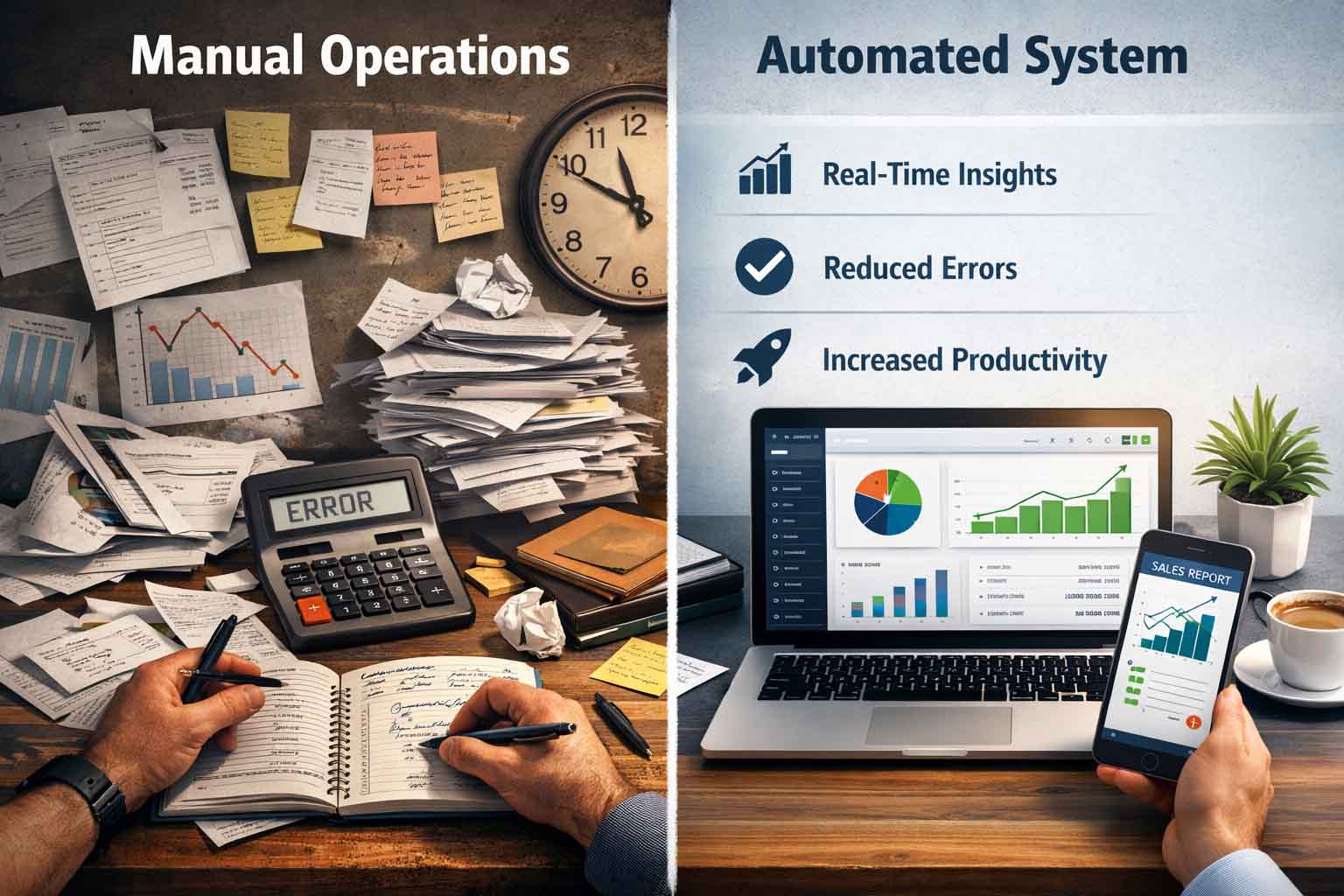
Manual processes are slowing your business growth. Discover why businesses in India & Malaysia are switching to automation systems in 2026.
Why Businesses Are Moving from Manual to Automated Systems in 2026
Businesses are not switching to automation because it’s trending.
They are switching because manual operations are quietly draining revenue every single day.
If you're still managing operations using Excel sheets, paperwork, or disconnected tools, you're not just behind — you're losing time, money, and control.
In 2026, the shift is no longer optional. It’s survival.
Businesses that delay this shift often realize the impact only after facing operational losses.
If you're still relying on manual processes, it’s time to assess where your business is losing efficiency
Feel free to talk to our experts today
The Real Problem with Manual Business Operations
Most business owners don’t realize how much they are losing until it’s too late.
Here’s what manual systems actually cause:
- Errors in billing, reporting, and data entry
- Lack of real-time visibility into operations
- Delayed decision-making
- Poor customer experience
- Data mismanagement and duplication
- Revenue leakage due to inefficiencies
These are not small issues.
They compound daily and directly affect profitability.
This is exactly why many growing businesses are now replacing manual systems with custom-built automation software designed for their workflows.
Why Businesses Are Rapidly Moving to Automation in 2026
1. Real-Time Control Over Operations
Automated systems give you live insights into your business — from sales to inventory to employee performance.
No more guessing. No more waiting.
2. Reduced Human Errors
Manual entries are prone to mistakes.
Automation ensures accuracy in billing, reporting, and tracking.
Businesses often underestimate how costly small errors can become over time.
A centralized system eliminates these risks completely.
3. Faster Decision Making
With centralized dashboards, business owners can make quick, data-driven decisions instead of relying on outdated reports.
4. Improved Customer Experience
Automation speeds up processes like billing, service delivery, and communication — leading to better customer satisfaction and retention.
5. Scalable Growth
Manual systems break when your business grows.
Automation is built to scale with you.
What Type of Businesses Are Adopting Automation?
This shift is happening across industries in both India and Malaysia:
- Retail businesses moving to POS systems
- Service businesses adopting custom management software
- Educational institutions implementing LMS platforms
- Salons and small businesses replacing manual bookings
- Organizations digitizing operations with ERP systems
No matter the industry, the pattern is clear:
Businesses that automate grow faster.
From retail POS systems to fully integrated management platforms, automation is becoming the foundation of modern business operations.
The Solution: Custom Business Automation Systems
Not every business is the same.
That’s why generic software often fails.
What works today is custom-built automation systems tailored to your business workflow.
At Grasp Software Solutions, businesses are moving away from:
- Excel-based tracking
- Manual billing systems
- Disconnected tools
And upgrading to:
- ERP solutions
- Custom management systems
- Integrated business dashboards
- Mobile and web-based platforms
Why Businesses Choose Grasp Software Solutions
Choosing the right technology partner is as important as choosing the software.
Grasp Software Solutions focuses on building systems that solve real business problems, not just adding features.
What you get:
- Tailor-made business automation systems
- Scalable ERP solutions
- Industry-specific management software
- Web and mobile integration
- Ongoing technical support
The goal is simple:
Help your business run faster, smarter, and more profitably.
Stop Losing Revenue to Manual Processes
Every day you delay automation, your business continues to lose:
- Time
- Accuracy
- Opportunities
The longer you stay manual, the harder it becomes to compete.
Every day your business runs on manual processes, you are losing time, accuracy, and revenue.
Automation is no longer a future upgrade—it’s a present necessity.
Speak with our experts today and discover how a custom automation system can streamline your operations and increase efficiency:
FAQs
1. Why are businesses moving to automation in 2026?
Businesses are moving to automation to reduce errors, improve efficiency, and gain real-time control over operations.
2. What are the risks of manual business processes?
Manual processes lead to errors, delays, data loss, and reduced productivity, impacting overall business performance.
3. How does automation improve business efficiency?
Automation eliminates repetitive tasks, speeds up operations, and ensures accurate data management.
4. Is automation suitable for small businesses?
Yes, automation helps small businesses scale faster by improving efficiency and reducing operational costs.
5. What type of software is used for business automation?
ERP systems, custom management software, POS systems, and mobile applications are commonly used.
6. How do I choose the right automation system?
Choose a system that fits your business workflow and can scale as your business grows.
7. Can automation reduce business costs?
Yes, automation reduces manual labor, minimizes errors, and improves overall efficiency, lowering costs.
8. Why choose custom software over ready-made tools?
Custom software is designed specifically for your business needs, ensuring better performance and flexibility.
Comments (0)
Comments are currently disabled. Stay tuned for updates!