



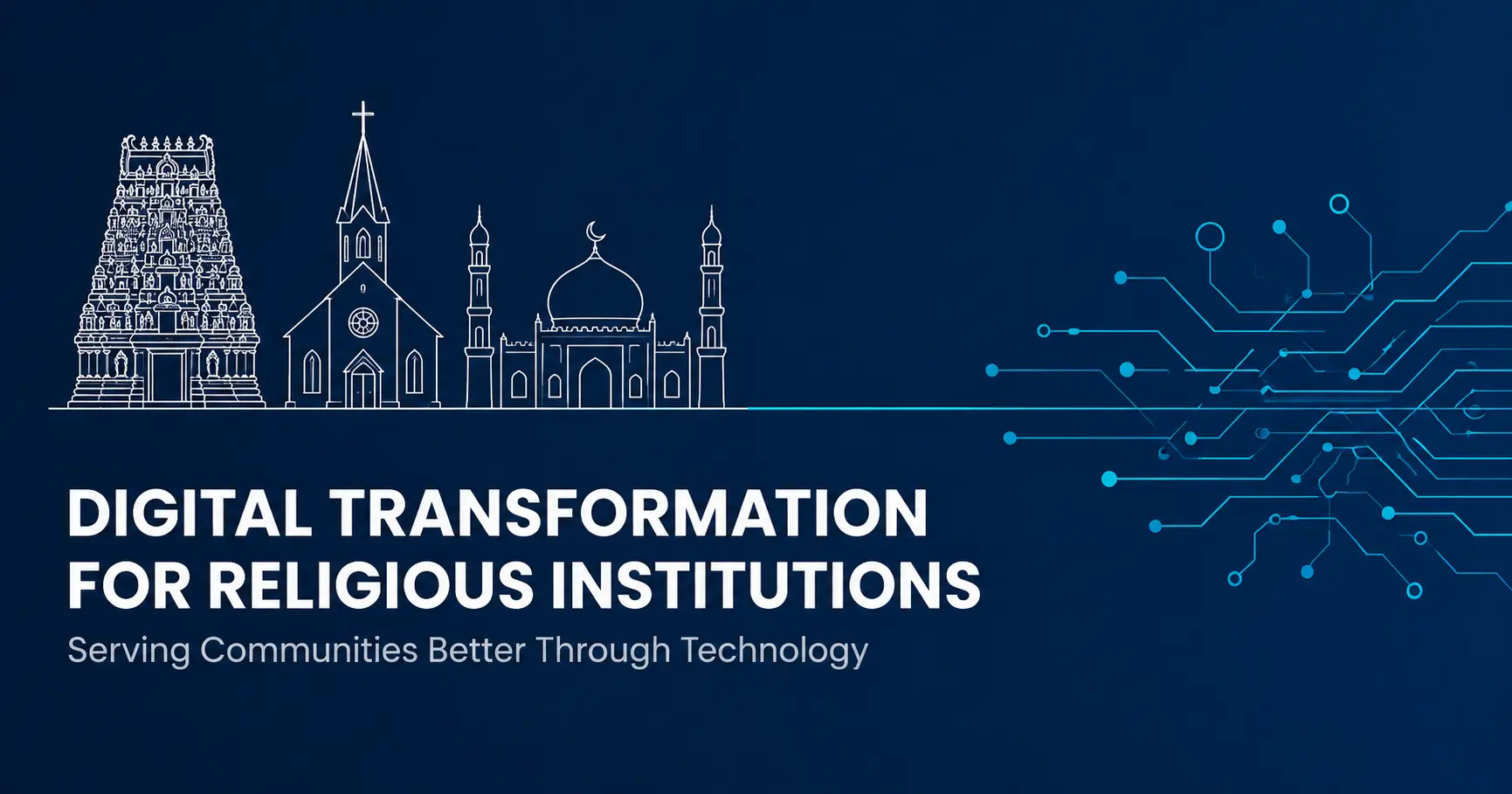
Religious institutions are using digital tools to serve communities better. Here's how temples, churches and mosques are putting technology to real use.
How Digital Transformation Is Helping Religious Institutions Serve Communities Better
When people hear "digital transformation" applied to a temple or a church or a mosque, they usually picture the operational side. Faster billing. Digital receipts. Better accounting. And yes, those things matter. But they're not the reason communities actually feel the difference.
The shift that congregations and devotees notice isn't the back-office improvement. It's the front-door improvement. Shorter queues on a busy day. The ability to book a pooja or make a donation from home when you can't physically visit. Receipts that arrive on your phone instead of a torn slip you'll lose by evening. A community that can see, transparently, how its contributions are being used. Real-time information about events, festivals, and services without having to call the office and hope someone picks up.
That's what digital transformation actually looks like when it's done well for a religious institution. Not technology for its own sake, but technology that removes the small frictions between the institution and the people it serves.
The community problems that digital solves
Religious institutions exist to serve people. When their operations are slow, opaque, or inconvenient, it's not just an admin problem. It's a barrier between the institution and the community it's supposed to support.
Long queues drive people away
A temple during a festival weekend or a church on a major holiday can have queues that stretch for hours. Some people wait. Many leave. The institution loses not just the offering or donation, but the participation. The person who drove forty minutes and couldn't get through the queue doesn't come back for the next event. Over time, operational friction quietly shrinks the active community.
Self-service kiosks, mobile booking systems, and digital payment options don't eliminate queues entirely, but they reduce them dramatically. A devotee who has pre-booked their pooja walks past the queue. A family that donates via QR code doesn't need to stand in line at the counter. The institution serves more people in the same hours with less frustration on both sides.
Distance excludes devoted members
Every religious community has members who can't always visit in person. They've moved to another city. They're elderly and can't travel easily. They're working abroad. In a paper-only institution, these people are effectively cut off. They can't make offerings, can't book services, can't participate in festivals, and can't contribute to the institution they still feel connected to.
A mobile app or online booking system re-includes these people. A devotee in Singapore can book an archanai at their home temple in Tamil Nadu. A family in London can sponsor an annathanam for a festival they can't attend. An elderly member can make their regular donation without travelling. Digital doesn't replace the physical visit. It extends the institution's reach to the people who want to participate but can't be there in person.
Lack of transparency erodes trust
This is the one religious institutions don't like to talk about publicly, but every committee knows it's real. When a community contributes money, whether as donations, tithes, offerings, or membership fees, they trust the institution to use it well. But trust without transparency is fragile. When members can't see how funds are used, when accounts are opaque, when questions about spending go unanswered, that trust erodes quietly. People don't stop believing. They stop giving.
Digital systems change this by making transparency the default rather than something the institution has to actively produce. When every donation is digitally recorded with a receipt, when the accounts are clean and auditable, when the institution can share financial summaries with the community confidently, trust strengthens. People give more, not less, when they can see their contributions are managed well.
Communication is one-directional or absent
Many religious institutions still communicate with their community through notice boards, word of mouth, or phone trees. These work for small, local congregations. They fail completely for larger communities, for members who live far away, or for time-sensitive information like schedule changes or emergency announcements.
Digital communication, whether through a dedicated app, email, SMS, or social media, makes the institution accessible. A temple can notify all registered devotees about a festival schedule change in minutes. A church can share its weekly service recording with members who couldn't attend. A mosque can send Ramadan timetables to every registered family. The community stays connected regardless of physical proximity.
How this looks across different institutions
The community-serving benefits of digital apply across every type of religious institution, even though the specific operations differ.
Temples
Hindu temples have some of the most complex daily operations of any religious institution. Multiple deities, each with their own poojas and timings. Archanai, vilakku, ubayam, prasadam, and annathanam, all as separate service categories. Priest commissions tied to specific rituals. Festival seasons with thousands of devotees in a single day.
Temple Management Software by Grasp was built specifically for this complexity. It handles counter billing, donation tracking, accounting, self-service kiosks, and a devotee mobile app, all in Tamil and English. The system serves over 90 temples across Malaysia, Singapore, India and the USA, and it works because it was designed from day one around how a temple actually operates, not adapted from retail software. For temples, the community-serving impact is immediate: shorter queues, transparent finances, and devotees who can participate from anywhere through the app.
Churches
Church operations typically centre around membership management, giving and tithing records, event scheduling, and volunteer coordination. Digital tools help churches track giving patterns (so pastoral care can reach out when a regular member stops contributing), coordinate service schedules across multiple ministries, and keep the congregation informed through apps and email.
Mosques
Mosques manage prayer timetables, community programmes, Zakat and Sadaqah collections, educational classes, and facility bookings. Digital systems help automate prayer-time calculations, track charitable giving with proper receipts, manage class registrations, and coordinate community welfare programmes.
Gurdwaras
Gurdwaras coordinate langar (community kitchen) operations, manage volunteer rotas, handle donations and community fund allocations, and run educational and social programmes. Digital tools help plan langar provisions based on expected attendance, track volunteer participation, and maintain transparent financial records for the community.
What changes for the community member
The individual devotee, congregant, or community member experiences the shift as a series of small but meaningful improvements.
The queue that used to take forty minutes now takes ten. The donation they make gets a proper digital receipt they can use for their records. The festival they can't attend in person, they can still participate in through an online booking. The accounts they used to wonder about are now summarised and shared. The event they almost missed was announced on the app three days in advance.
None of these is dramatic on its own. But together they add up to an institution that feels more accessible, more accountable, and more connected to the people it serves. And that's the point of digital transformation for a religious institution. Not to become a tech company, but to remove every unnecessary barrier between the institution and its community.
Why purpose-built software matters for this
The community-serving benefits described above don't come from generic business software. A retail POS can speed up a counter, but it can't handle archanai categories or Zakat tracking. A generic CRM can store member records, but it doesn't understand tithing patterns or pooja bookings. The institutions that see the real impact are the ones using software designed for how religious organisations actually work, built around their specific operations, their terminology, and their community relationships.
That's the approach Grasp Software Solutions takes across every industry we build for. Whether it's temples, restaurants, unions, or cooperatives, the software is shaped around the specific institution's operations, not the other way around.
Getting started
If your religious institution is considering digital tools to better serve your community, we'd be happy to talk about what that looks like for your specific situation. Get in touch with our team and we'll give you an honest assessment of whether a digital system makes sense for your institution and what the first steps would be.
Frequently asked questions
Does digital transformation mean the institution loses its traditional character?
Not at all. Digital tools handle the operational and administrative side. The rituals, the worship, the community traditions stay exactly as they are. What changes is how smoothly the institution runs underneath, not what it does or what it stands for.
Is this only for large institutions?
No. Even a small temple or church with a few hundred regular members benefits from proper donation tracking, digital receipts, and simple communication tools. The scale of the system matches the scale of the institution.
How long does it take to see the community impact?
Most institutions notice the difference within the first month. Faster service, cleaner receipts, and better communication are immediate. Deeper impacts like improved transparency and re-engagement of distant members build over three to six months.
What if our community members aren't tech-savvy?
The institution's staff use the system. Community members interact with the results: shorter queues, digital receipts, an app for bookings. They don't need to learn any software. The technology is invisible to the community member, only the benefit is visible.
Does Grasp build software for all types of religious institutions?
Grasp's flagship product, Temple Management Software by Grasp, is purpose-built for Hindu temples. For other types of religious institutions, we offer custom software development tailored to their specific operations. Reach out and we'll discuss what's possible for your institution.
What about data privacy for community members?
Member and devotee data is stored securely and accessed only by authorised staff. Religious institutions have a duty of care toward their community's personal information, and the software is built to support that responsibility.
Comments (0)
Comments are currently disabled. Stay tuned for updates!